
Autobiography
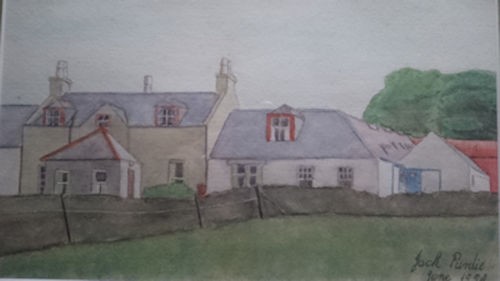
I was born and grew up at Drumjoan, a dairy farm in Ochiltree parish in Ayrshire, Scotland.
During my high school years, at Cumnock academy, I learned to play the bagpipes, instructed by Jimmie Dungavel, pipe major of the Ayr Pipe Band. I also enjoyed sports, particularly rugby and gymnastics, encouraged by John (stiffy) McClure. I went on various climbing expeditions in Arran and in the Scottish highlands organised by two teachers, Robert Dalgleish and Fred McNeillie. Tom Bain was my regular climbing companion. Later, I camped and climbed in the Cairngorm mountains with Tom but our most ambitious (and foolish) expedition was attempting to climb Mt. Niesen in Switzerland. It was during the Easter break and we were staying at Thun in the Bernese Oberland. The mountain was snow covered but we climbed up part way through forest on the lower slopes. After about two hours we turned back and descended to the base of the mountain. As we emerged from the woods we were met by two frontier policemen who were waiting for us. After examining our passports and ID they warned us not to climb mountains at that time of year. “Ces dangereux! Avalancheux!” they repeated several times. We had never encountered such conditions in Scotland but we took their advice.
After completing high school at Cumnock Academy in Ayrshire, I went to Glasgow University where I obtained an honours degree in chemistry. For graduate work I moved to Birmingham University, England, and gained a Ph.D. My research focused on separating sub-humic acids produced by ozonisation of coal using ion exchange resin and identifying the chemical structures. The substances characterized provided information about the chemical constitution of coal.
My next step was to Ottawa, Canada as a Postdoctoral Fellow at the National Research Council of Canada (NRC) to work with Stan Holt. I determined the chemical structures of twelve novel chlorophylls, the 650 and 660 Chlorobium chlorophylls, and developed a novel method to isolate chlorophyll C using ion exchange resins.
Following my fellowship at NRC I took a position at the Defence Research Board. My project was to elucidate the mechanism of action of radioprotective aminothiols. My research eventually culminated in discovery of the mechanism of radioprotection with aminothiols and a detailed account was published in 1983. (See article on amifostine). The paper inspired a surge of research in the field which confirmed my conclusion that anoxia is the principal mode of action of these chemicals. This led to approval of the drug, amifostine, for use in radiation oncology. My seminal report is still being cited more than three decades after publication.
Following my successful research career, I transferred to DSTI to conduct analysis of Scientific and Technical Intelligence and continued in that work until I retired from Government of Canada service in 2001.
I am currently writing science fiction novels, a medium that allows me to explore ideas which could not be taken further in scientific journals or government reports. I specialize in “Hard Science Fiction” in which the basic laws of science are not violated. Nevertheless, there may be unsurmountable hurdles to development of some of the technology projected.
July 2018