Mechanization at Drumjoan Farm
My early years were spent at Drumjoan, a dairy farm in Ayrshire, Scotland. It is fascinating to look at the changes since that period from a technology perspective. At that time, in the early 1940s, the main source of power was muscle; humans and horses. However, it has moved gradually from men, women and Clydesdales to tractors and other equipment powered by internal combustion engines or electricity. Clydesdales horses are large draft horses, usually obedient and mild tempered. They are strong and quite heavy as I found when one stepped on my foot while pulling a load. However, occasionally one would take exception to the field work and quit; one horse was prone to suddenly head for home and jump a dyke or fence with an implement dragging behind.
In those early days dairy farms relied on grass in the summer and mainly hay and oats to feed the livestock in the winter. The hay was cut in early summer and the swaths were allowed to dry on the ground, turned over once or twice with a turner before being collected together with a horse-drawn rake and built into hayricks in the field by men and women using long-handled forks. The hayricks were allowed to cure for a week or more before being carted to the farm steading where the hay was transferred to a large covered hayshed or a larger rick for storage. A horse fork was sometimes used in the hayshed to lift the hay onto high hay dashes. If the moisture content of the hay was not reduced enough in the field there was a risk of it 'heating' in the shed; this was a fermentation process that could get very hot and spoil the quality of the hay.
In Scotland oats typically ripen to golden yellow in August. When I was young a McCormick reaper-binder was already in use on the farm. This implement, drawn by three horses, cut the crop and tied it in sheaves with twine. From there on manpower was required to stook the sheaves in groups of six in the field with the grain upwards where they would sit for a week or more to dry before being carted to the farmstead and built into large stacks. The stacks were thatched to protect the grain for threshing at a later date. The stacks and the sacks of oats obtained by threshing were attractive to mice so it was highly desirable to have several cats on the farm. They were not tame pets but would come for milk each day.
Threshing in those days was done by a big travelling mill which would be moved from farm to farm. The mill was often accompanied by a baler and a caravan for the mill-men and the whole convoy was drawn by a large steam powered tractor with metal wheels. It was an impressive sight, especially on the narrow roads in the district. The steam tractor also powered the threshing mill and baler by means of long belts so the assembly had to be lined up carefully in order to function. The arrangement for fuel was that each farm would supply the coal needed for the threshing and enough for the journey to the next farm. On one occasion at a neighbouring farm the mill-man, Jackie, kept adding a lump of coal each time he passed the engine joking:
"A long way to go tonight!" By the end of the day coal was piled high on the engine. However, the wily old farmer was not amused so when the workers went in for tea at the end of the day he removed all the coal and filled the container level full with stones covered with a small pile of coal. Jackie never made it to the next farm - he had to send for help.
Mill day required extra manpower so several farms would cooperate and send men to help each other with the threshing. It also meant extra work in the kitchen as everyone had to have lunch and tea. My mother caused a sensation one time when she gave them corned beef for lunch at a time when rationing was still in effect. The visiting men returned home and reported that they had been served steak for lunch!
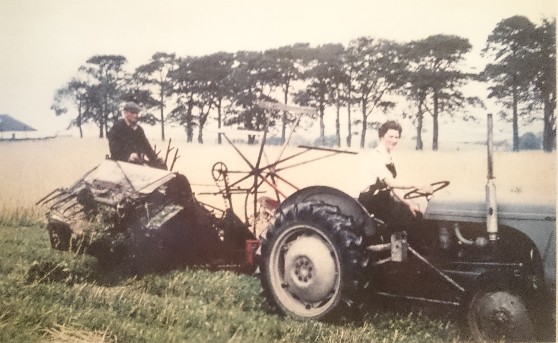
The first tractor on the farm, a Fordson which used petrol (gasoline) to start then operated on paraffin (kerosene), was introduced in 1942. Thirteen years later it was joined by a smaller diesel-powered Ferguson. This tractor was equipped with the three-point Ferguson hydraulic system that allowed many implements to be attached directly to the tractor rather than drawn. The controls of the Ferguson differed in some respects from the Fordson where the clutch and brake were combined. This caused some initial problems on the rolling landscape of Ayrshire. One day Johnny stopped the Ferguson near the top of a steep slope and stepped off without the brake on. Before he could do anything the tractor-trailer started to roll and picked up speed as it went down the hill. The rough ground caused the pin to come out leaving the trailer behind. Johnny ran after it shouting;
"Whoa! Whoa!" but the tractor paid no heed. At the bottom of the field the tractor hit a pile of stones, leapt into the air, jumped clean over a stone March dyke and came to rest in the soft mud of a burn about fifty yards further on; virtually undamaged. The little Grey Fergie was not only flexible but agile as well. The old Fordson continued to be used until about 1960.
In general, changing from horse drawn power to tractors went smoothly. There were a few initial problems until drivers learned that a tractor pulling a plough in the ground can't be steered; some ended up in a burn. During ploughing Jonny would often sing as he cruised along at ploughing speed but when a stone was encountered the song would stop and a string of choice words would draw attention to the situation. With more and more work being done by tractors, the number of horses was reduced from five to one which was kept until 1955 for occasional use during harvest season. When collecting the sheaves of oats in the field, the horse had an advantage over a tractor as you could tell it to go and it would move to the next stook then wait. Unfortunately, as the horse did not have regular work it became unfit and incapable of anything except light work.
A major step in mechanization of the hay harvest was a Welger baler in 1958 to collect the hay directly in the field and compress it into square bales tied with twine. The baled hay still had to spend a week or so in the field to dry but the bales made handling much easier at the farmstead, both during storage in summer and removal in winter. Later, in 1985 a Claas round baler was obtained. It rolls up the hay into large round bales about six feet in diameter which shed rain better than square bales, an important consideration in Ayrshire. The round bales are too heavy to manhandle but can be moved easily by a front-end loader and can be rolled out like a carpet to feed the animals. Making hay in Ayrshire has always been tricky because of the weather. To overcome this many farms switched to silage whereby the grass is cut and chopped even if it is wet then placed in a silage tower or in a pit sealed in with an airtight cover. Two towers were built at Drumjoan in 1976 but they have since been dismantled in favour of silage pits. The silage ferments in the absence of air, producing a fodder high in nutrients. Specialized equipment is used to cut and remove the silage in winter for feeding. The animals seem to prefer silage to dry hay. It makes one wonder what other by-products are produced in the fermentation. The cows don't sing but some do become quite vocal - especially if the feeding is late.
Mechanization of the grain harvest was achieved 1979 by the introduction of a Claas self-powered combine harvester. Using heavy implements on farms in Ayrshire has to be undertaken with careful regard to the local climate. With frequent rain the ground is often too soft to support heavy equipment. For this reason a self-powered harvester was more successful than a drawn one. The grain collected from the harvester was dried and stored in a silo. This led to a change from oats to barley as the preferred crop. Barley is unpleasant if it has to be handled but is more suitable for combining. Surplus barley may also be sold to Johnny Walker in Kilmarnock.
Improvements also occurred in the collection and handling of milk on the dairy farm. An Alfa Laval milking machine was installed in 1939 at a time when about 50 cows were being milked. It was powered by a Lister diesel engine which was adapted to generate electricity for lighting on the farm. Vacuum pipes went from the pumping machine to all the cow stalls. Herbert Siemans taught me my first gymnastics using the pipe as a horizontal bar. In my days on the farm the milk was cooled and collected in 10 gallon cans. A truck came each day to collect the milk cans, transport them to a dairy, and return the empty cans to be cleaned and steam sterilized. Frequently the milk was taken to a dairy in Glasgow and occasionally we were allowed to go with the truck for an outing to the big city.
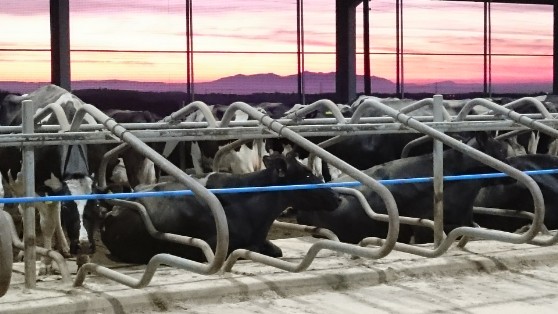
The first major change came in 1960 with the use of a bulk refrigerated tank to hold the milk at the farm until it was collected by a tanker truck. When the milk was 10 gallon cans, the dairy would do random sampling at the dairy to check for tampering such as adding water to the milk. With the bulk tanks a sample was taken at each farm befor loading to the truck. If tampering was detected when the milk arrived at the destination dairy, the tanker company could vary the route each day to pin down the culprit and thwart the errant farmer. Since the dairy could refuse to buy from a farm if the milk was tampered with, the onus was on the farmers to make sure the milk was 'pure'. Another change at that time was the use of a milking parlour rather than milking at each position in the byre. By 1985 100 cows were being milked each day but the number was reduced to approximately 80. They were kept in a cubical house which gave them individual stalls to lie in but freedom to move about rather than being chained up. Beginning in 2008 the number of milking cows was reduced gradually by selling them off at appropriate times and dairying ceased at Drumjoan.
On recent visits to the farm I was impressed by the extent of mechanization; several large powerful tractors, and a range of equipment for harvesting and handling operations. Muscle power has been replaced by energy from fossil fuels or electricity at the farm. Field work especially has been highly mechanized. A small number of men or women can operate a large farm and milk up to 100 cows daily. However, mechanization comes at a cost and inflation is significant. The original Fordson tractor cost £100 whereas a modern farm tractor sells for about £80,000. Likewise the cost of a combine harvester has increased from £1700 in 1969 to about £200,000 today.
Artificial intelligence (AI) is also creeping into the dairy industry. Some farmers in Ayrshire have installed automatic milking machines. These work by enticing the cow into the milking parlour with food. Once in position the udder is washed and the milking cups attached by the milking machine without human intervention. When milking has finished the unit is detached and the cow is encouraged to exit the parlour. It is easy to foresee other routine tasks being automated. If AI can drive cars successfully it can be adapted to drive a tractor. Ploughing may be difficult as the automatic machine may not have the vocabulary to describe the situation when a large stone is encountered.
I would like to thank my brother, Davie, and my niece, Sheena Gemmell, for providing some of the information and confirming many of the dates in this article.